Ant Colony Optimization with a Java Example
Last updated: January 8, 2024


Mocking is an essential part of unit testing, and the Mockito library makes it easy to write clean and intuitive unit tests for your Java code.
Get started with mocking and improve your application tests using our Mockito guide:
Handling concurrency in an application can be a tricky process with many potential pitfalls. A solid grasp of the fundamentals will go a long way to help minimize these issues.
Get started with understanding multi-threaded applications with our Java Concurrency guide:
Spring 5 added support for reactive programming with the Spring WebFlux module, which has been improved upon ever since. Get started with the Reactor project basics and reactive programming in Spring Boot:
Since its introduction in Java 8, the Stream API has become a staple of Java development. The basic operations like iterating, filtering, mapping sequences of elements are deceptively simple to use.
But these can also be overused and fall into some common pitfalls.
To get a better understanding on how Streams work and how to combine them with other language features, check out our guide to Java Streams:
Explore Spring Boot 3 and Spring 6 in-depth through building a full REST API with the framework:
Yes, Spring Security can be complex, from the more advanced functionality within the Core to the deep OAuth support in the framework.
I built the security material as two full courses - Core and OAuth, to get practical with these more complex scenarios. We explore when and how to use each feature and code through it on the backing project.
You can explore the course here:
Spring Data JPA is a great way to handle the complexity of JPA with the powerful simplicity of Spring Boot.
Get started with Spring Data JPA through the guided reference course:
Refactor Java code safely — and automatically — with OpenRewrite.
Refactoring big codebases by hand is slow, risky, and easy to put off. That’s where OpenRewrite comes in. The open-source framework for large-scale, automated code transformations helps teams modernize safely and consistently.
Each month, the creators and maintainers of OpenRewrite at Moderne run live, hands-on training sessions — one for newcomers and one for experienced users. You’ll see how recipes work, how to apply them across projects, and how to modernize code with confidence.
Join the next session, bring your questions, and learn how to automate the kind of work that usually eats your sprint time.
Distributed systems often come with complex challenges such as service-to-service communication, state management, asynchronous messaging, security, and more.
Dapr (Distributed Application Runtime) provides a set of APIs and building blocks to address these challenges, abstracting away infrastructure so we can focus on business logic.
In this tutorial, we'll focus on Dapr's pub/sub API for message brokering. Using its Spring Boot integration, we'll simplify the creation of a loosely coupled, portable, and easily testable pub/sub messaging system:
1. Introduction
The aim of this series is to explain the idea of genetic algorithms and show the most known implementations.
In this tutorial, we’ll describe the concept of the ant colony optimization (ACO), followed by the code example.
2. How ACO Works
ACO is a genetic algorithm inspired by an ant’s natural behavior. To fully understand the ACO algorithm, we need to get familiar with its basic concepts:
- ants use pheromones to find the shortest path between home and food source
- pheromones evaporate quickly
- ants prefer to use shorter paths with denser pheromone
Let’s show a simple example of ACO used in the Traveling Salesman Problem. In the following case, we need to find the shortest path between all nodes in the graph:
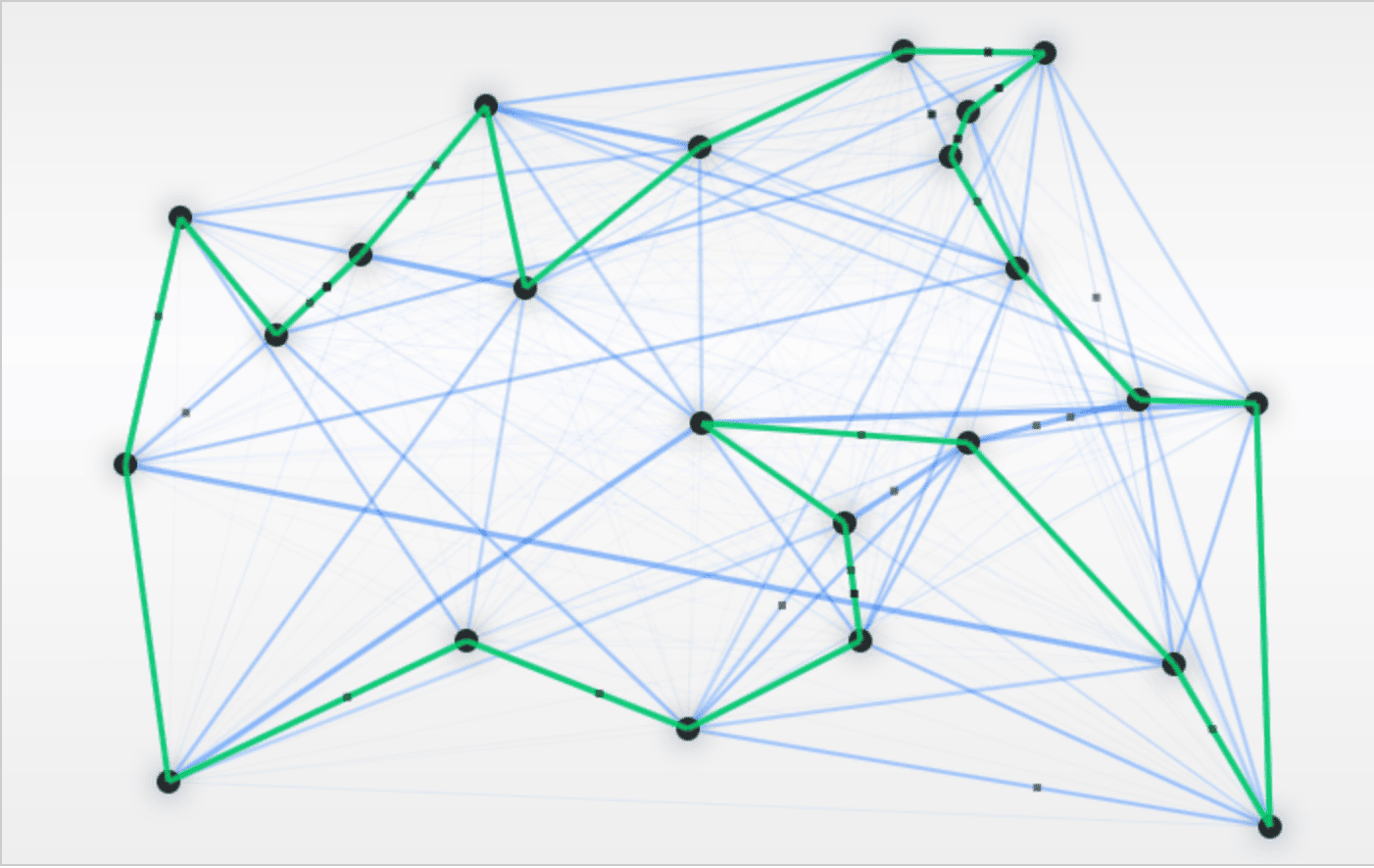
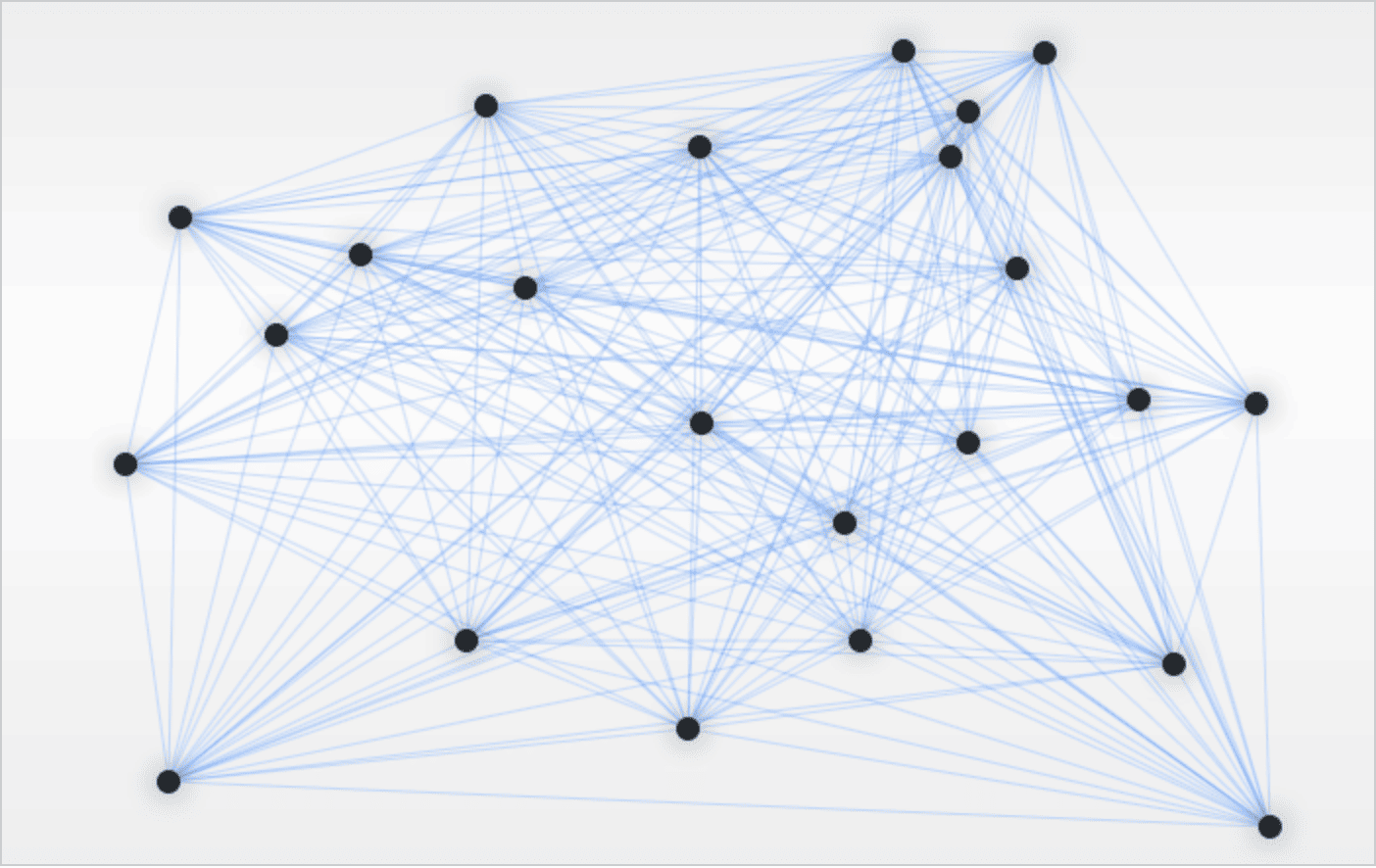 Following by natural behaviors, ants will start to explore new paths during the exploration. Stronger blue color indicates the paths that are used more often than the others, whereas green color indicates the current shortest path that is found:
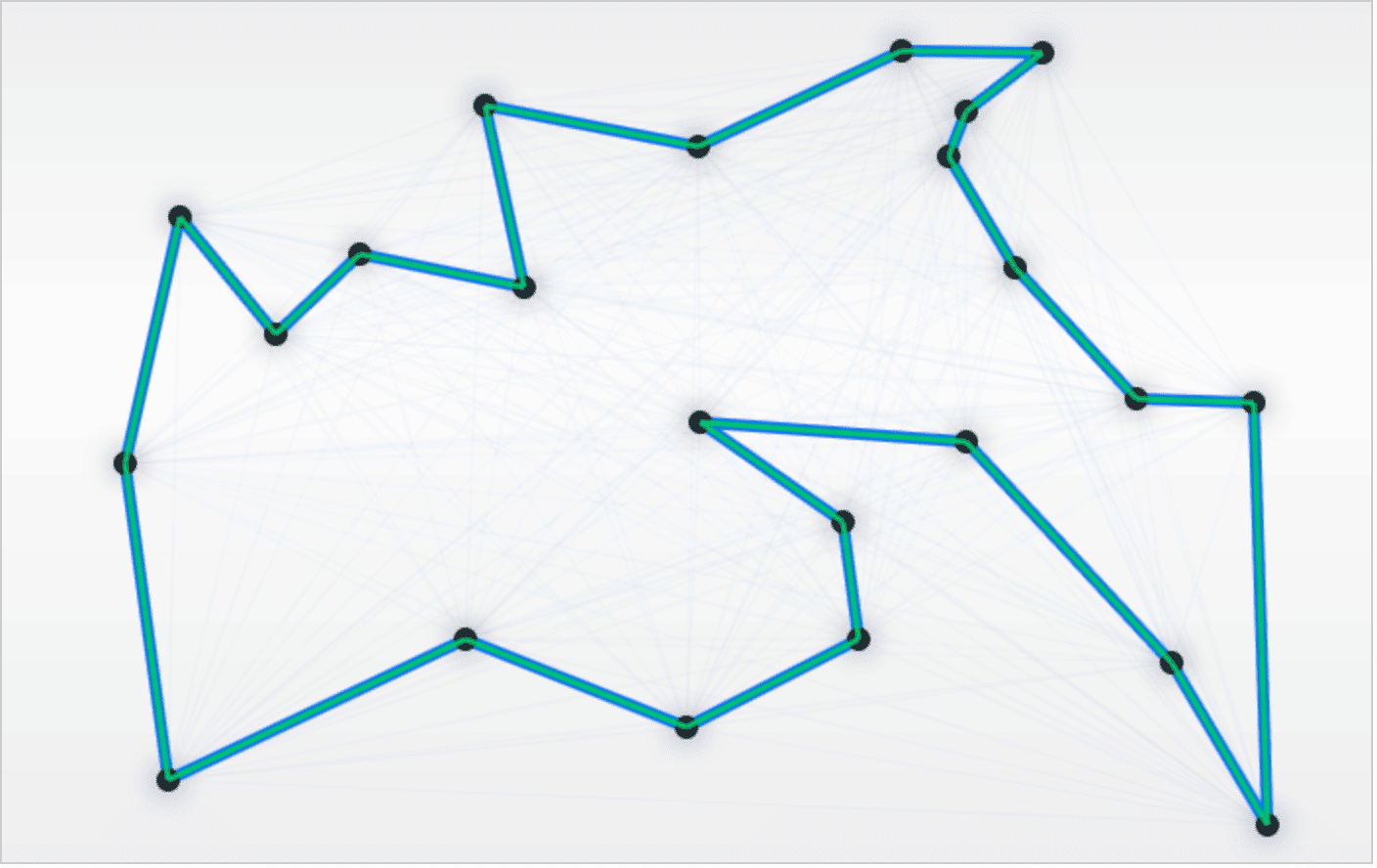
 As a result, we’ll achieve the shortest path between all nodes:
 The nice GUI-based tool for ACO testing can be found here.
3. Java Implementation
3.1. ACO Parameters
Let’s discuss the main parameters for the ACO algorithm, declared in the AntColonyOptimization class:
private double c = 1.0;
private double alpha = 1;
private double beta = 5;
private double evaporation = 0.5;
private double Q = 500;
private double antFactor = 0.8;
private double randomFactor = 0.01;
Parameter c indicates the original number of trails, at the start of the simulation. Furthermore, alpha controls the pheromone importance, while beta controls the distance priority. In general, the beta parameter should be greater than alpha for the best results.
Next, the evaporation variable shows the percent how much the pheromone is evaporating in every iteration, whereas Q provides information about the total amount of pheromone left on the trail by each Ant, and antFactor tells us how many ants we’ll use per city.
Finally, we need to have a little bit of randomness in our simulations, and this is covered by randomFactor.
3.2. Create Ants
Each Ant will be able to visit a specific city, remember all visited cities, and keep track of the trail length:
public void visitCity(int currentIndex, int city) {
    trail[currentIndex + 1] = city;
    visited[city] = true;
}

public boolean visited(int i) {
    return visited[i];
}

public double trailLength(double graph[][]) {
    double length = graph[trail[trailSize - 1]][trail[0]];
    for (int i = 0; i < trailSize - 1; i++) {
        length += graph[trail[i]][trail[i + 1]];
    }
    return length;
}
3.3. Setup Ants
At the very beginning, we need to initialize our ACO code implementation by providing trails and ants matrices:
graph = generateRandomMatrix(noOfCities);
numberOfCities = graph.length;
numberOfAnts = (int) (numberOfCities * antFactor);

trails = new double[numberOfCities][numberOfCities];
probabilities = new double[numberOfCities];
ants = new Ant[numberOfAnts];
IntStream.range(0, numberOfAnts).forEach(i -> ants.add(new Ant(numberOfCities)));
Next, we need to setup the ants matrix to start with a random city:
public void setupAnts() {
    IntStream.range(0, numberOfAnts)
      .forEach(i -> {
          ants.forEach(ant -> {
              ant.clear();
              ant.visitCity(-1, random.nextInt(numberOfCities));
          });
      });
    currentIndex = 0;
}
For each iteration of the loop, we’ll perform the following operations:
IntStream.range(0, maxIterations).forEach(i -> {
    moveAnts();
    updateTrails();
    updateBest();
});
3.4. Move Ants
Let’s start with the moveAnts() method. We need to choose the next city for all ants, remembering that each ant tries to follow other ants’ trails:
public void moveAnts() {
    IntStream.range(currentIndex, numberOfCities - 1).forEach(i -> {
        ants.forEach(ant -> {
            ant.visitCity(currentIndex, selectNextCity(ant));
        });
        currentIndex++;
    });
}
The most important part is to properly select next city to visit. We should select the next town based on the probability logic. First, we can check if Ant should visit a random city:
int t = random.nextInt(numberOfCities - currentIndex);
if (random.nextDouble() < randomFactor) {
    OptionalInt cityIndex = IntStream.range(0, numberOfCities)
      .filter(i -> i == t && !ant.visited(i))
      .findFirst();
    if (cityIndex.isPresent()) {
        return cityIndex.getAsInt();
    }
}
If we didn’t select any random city, we need to calculate probabilities to select the next city, remembering that ants prefer to follow stronger and shorter trails. We can do this by storing the probability of moving to each city in the array:
public void calculateProbabilities(Ant ant) {
    int i = ant.trail[currentIndex];
    double pheromone = 0.0;
    for (int l = 0; l < numberOfCities; l++) {
        if (!ant.visited(l)){
            pheromone
              += Math.pow(trails[i][l], alpha) * Math.pow(1.0 / graph[i][l], beta);
        }
    }
    for (int j = 0; j < numberOfCities; j++) {
        if (ant.visited(j)) {
            probabilities[j] = 0.0;
        } else {
            double numerator
              = Math.pow(trails[i][j], alpha) * Math.pow(1.0 / graph[i][j], beta);
            probabilities[j] = numerator / pheromone;
        }
    }
}
After we calculate probabilities, we can decide to which city to go to by using:
double r = random.nextDouble();
double total = 0;
for (int i = 0; i < numberOfCities; i++) {
    total += probabilities[i];
    if (total >= r) {
        return i;
    }
}
3.5. Update Trails
In this step, we should update trails and the left pheromone:
public void updateTrails() {
    for (int i = 0; i < numberOfCities; i++) {
        for (int j = 0; j < numberOfCities; j++) {
            trails[i][j] *= evaporation;
        }
    }
    for (Ant a : ants) {
        double contribution = Q / a.trailLength(graph);
        for (int i = 0; i < numberOfCities - 1; i++) {
            trails[a.trail[i]][a.trail[i + 1]] += contribution;
        }
        trails[a.trail[numberOfCities - 1]][a.trail[0]] += contribution;
    }
}
3.6. Update the Best Solution
This is the last step of each iteration. We need to update the best solution in order to keep the reference to it:
private void updateBest() {
    if (bestTourOrder == null) {
        bestTourOrder = ants[0].trail;
        bestTourLength = ants[0].trailLength(graph);
    }
    for (Ant a : ants) {
        if (a.trailLength(graph) < bestTourLength) {
            bestTourLength = a.trailLength(graph);
            bestTourOrder = a.trail.clone();
        }
    }
}
After all iterations, the final result will indicate the best path found by ACO. Please note that by increasing the number of cities, the probability of finding the shortest path decreases.
4. Conclusion
This tutorial introduces the Ant Colony Optimization algorithm. You can learn about genetic algorithms without any previous knowledge of this area, having only basic computer programming skills.
For all articles in the series, including other examples of genetic algorithms, check out the following links:
- How to Design a Genetic Algorithm in Java
- The Traveling Salesman Problem in Java
- Ant Colony Optimization (this)