


Learn through the super-clean Baeldung Pro experience:
>> Membership and Baeldung Pro.
No ads, dark-mode and 6 months free of IntelliJ Idea Ultimate to start with.
Learn through the super-clean Baeldung Pro experience:
>> Membership and Baeldung Pro.
No ads, dark-mode and 6 months free of IntelliJ Idea Ultimate to start with.
Threads are usually described as lightweight processes. They run specific tasks within a process. Each thread has its id, a set of registers, the stack pointer, the program counter, and the stack.
However, threads share resources with one another within the process they belong to. In particular, they share the processor, memory, and file descriptors.
In this tutorial, we’ll explain how resource sharing works between threads.
To understand resource sharing, let’s first take a look at the memory map of a process:
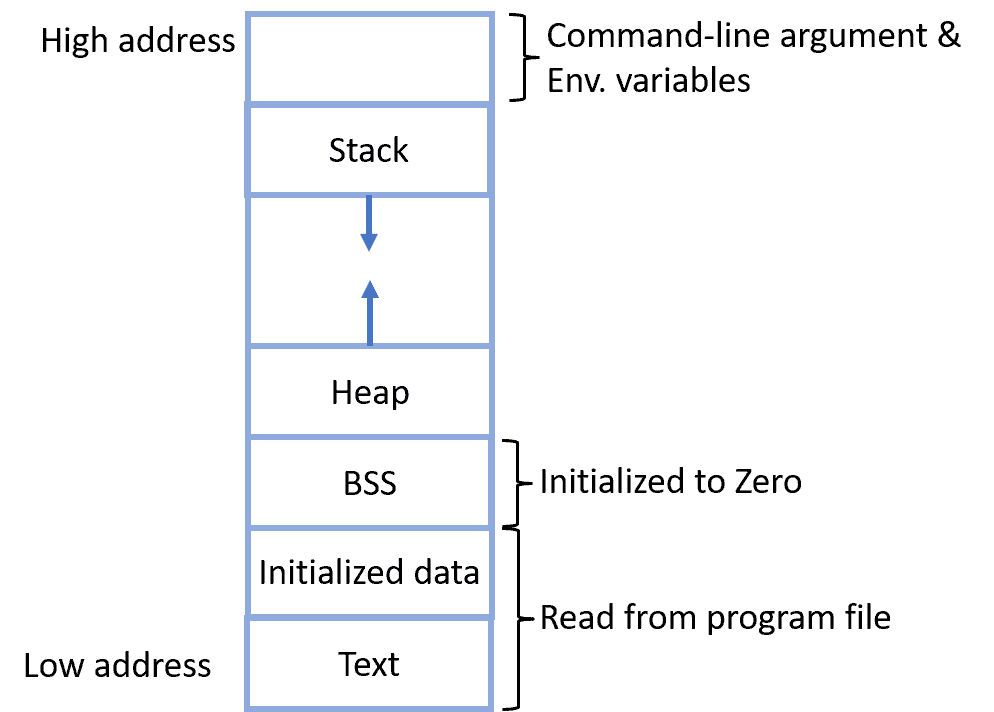
The memory is logically divided as follows:
There are two threading schemes: a process can have a single thread or contain multiple threads.
In single-threaded processes, there’s only one thread. As a result, we need only one program counter, and there’s only one instruction set to execute. On the other hand, multi-threaded processes contain several threads which share some resources while keeping others private:
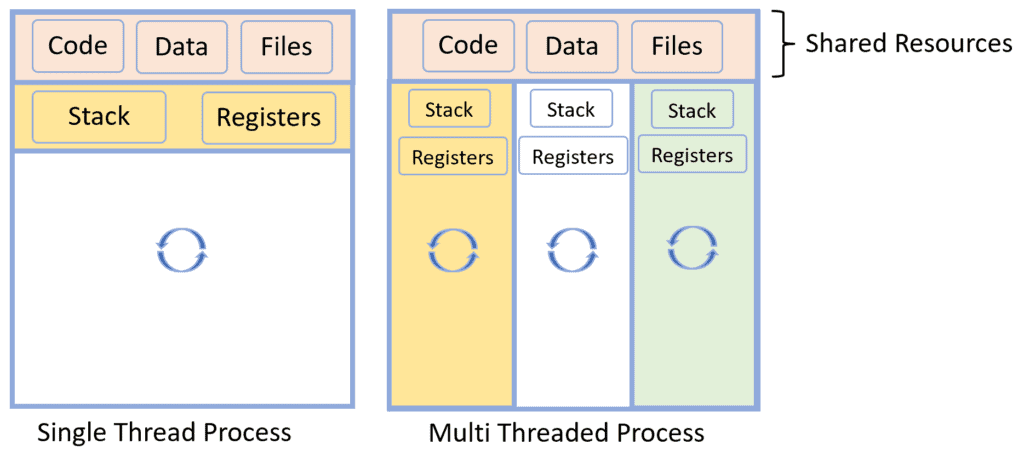
There are several benefits to using multiple threads:
However, we need to make threads access the shared resources in a safe way. That means that the resources are always in a consistent state. For example, no two threads should be allowed to change the same file at the same time because of the risk of overriding each other’s changes.
The operating system is responsible for scheduling all threads in a multi-threaded process. It keeps track of processes and their per-process information:
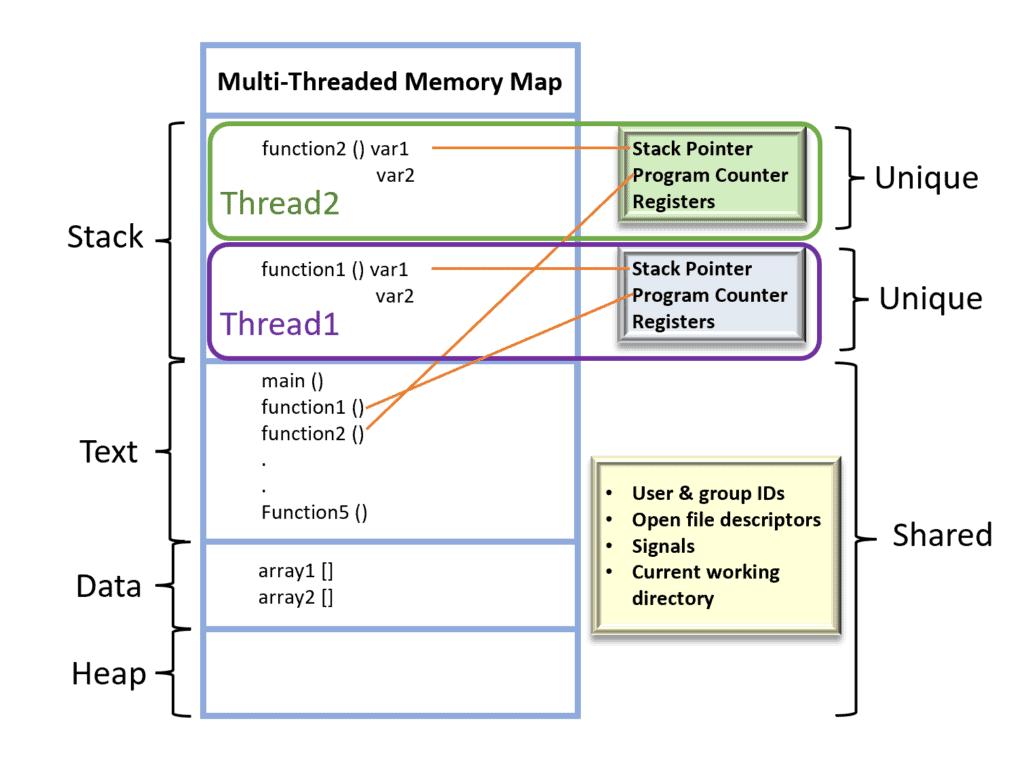
Some of these resources are private and visible only in the thread owning them, whereas others are shared across all the threads within the same process:
| Private Resources | Shared Resources |
|---|---|
| Thread ID | Instructions (Text/Code) |
| Registers | Static and global data (Data) |
| Stack pointer | Uninitialized data (BSS) |
| Instruction pointer | Open file descriptors |
| Stack | Signals |
| Signal mask | Current working directory |
| Policy or priority (scheduling information) | User and group IDs |
The process divides the stack area and gives each thread a portion of it.
As shown in the figure above, the allocated stack area for a thread contains at least the following:
In addition, when a thread completes its task, the stack area of the corresponding thread gets reclaimed by the process. So, although each thread has its own stack, thread-specific stacks are parts of the same stack area the process owns.
Threads also share some resources:
Shared resources make a thread lightweight because they reduce the overhead of resource allocation since it has already been done during the creation of the parent process.
In this article, we talked about how threads share resources within the same process. The code, data, and heap areas are shared, while the stack area only gets divided among threads.