
Learn through the super-clean Baeldung Pro experience:
>> Membership and Baeldung Pro.
No ads, dark-mode and 6 months free of IntelliJ Idea Ultimate to start with.
Last updated: May 5, 2023

Learn through the super-clean Baeldung Pro experience:
>> Membership and Baeldung Pro.
No ads, dark-mode and 6 months free of IntelliJ Idea Ultimate to start with.
In this tutorial, we’ll explain what’s a loop invariant and how we can use it to prove the correctness of our algorithms.
A loop invariant is a tool used for proving statements about the properties of our algorithms and programs. Naturally, correctness is the property we’re most interested in. We should be sure that our algorithms always produce correct results before putting them to use.
A loop invariant is a statement about an algorithm’s loop that:
If we can prove that those two conditions hold for a statement, then it follows that the statement will be true before each iteration of the loop. Furthermore, it follows that the last iteration won’t affect the invariant, so the two conditions ensure that the invariant is true after the loop as well.
As many algorithms do the actual work in the main loop updating their solution iteratively, the invariant we’re after will state a property of the variable(s) holding the solution. Additionally, the invariant should establish a meaningful relationship between the variable(s) and the number of iterations done. That relation should show that the solution contained in the variable(s) after the loop ends is indeed the correct solution the algorithm was supposed to find.
Let’s say that we want to sum an array of real numbers:
algorithm sumArray(a):
    // INPUT
    //    a = an array of n real numbers
    // OUTPUT
    //    The sum of all elements of a

    s <- 0
    for i <- 1 to n:
        s <- s + a[i]
    return s
To be sure that our algorithm works, we should prove that after the loop ends,  is equal to the sum of the numbers in
  :
:
![\[s = \sum_{i=1}^{n}a_i\]](/wp-content/ql-cache/quicklatex.com-9986f054b666fc86e16a1f9ab4d18d0d_l3.svg "Rendered by QuickLaTeX.com")
One way to do so is to formulate a loop invariant about variable :
At the beginning of the  -th iteration,
  is equal to the sum of the first
  elements of
  .
.
How do we check if this is a good invariant? We should verify that the invariant, applied to after the loop, describes the correct solution. In this example, the loop ends when  , so the invariant states that at the end of the loop
![\[s=\sum_{i=1}^{n}a_i\]](/wp-content/ql-cache/quicklatex.com-e32806e25160ca4bfb33552c09d654a5_l3.svg "Rendered by QuickLaTeX.com")
which is what we want our algorithm to return. So, we identified the invariant we should prove, but, how do we come up with proof?
Proving an invariant is similar to mathematical induction.
The requirement that the invariant hold before the first iteration corresponds to the base case of induction.
The second condition is similar to the inductive step.
But, unlike induction that goes on infinitely, a loop invariant needs to hold only until the loop has ended.
Unfortunately, as each algorithm is unique, there is no universal recipe for writing proofs. All the proofs will have the same structure:
but each step in the process will depend on the actual algorithm:
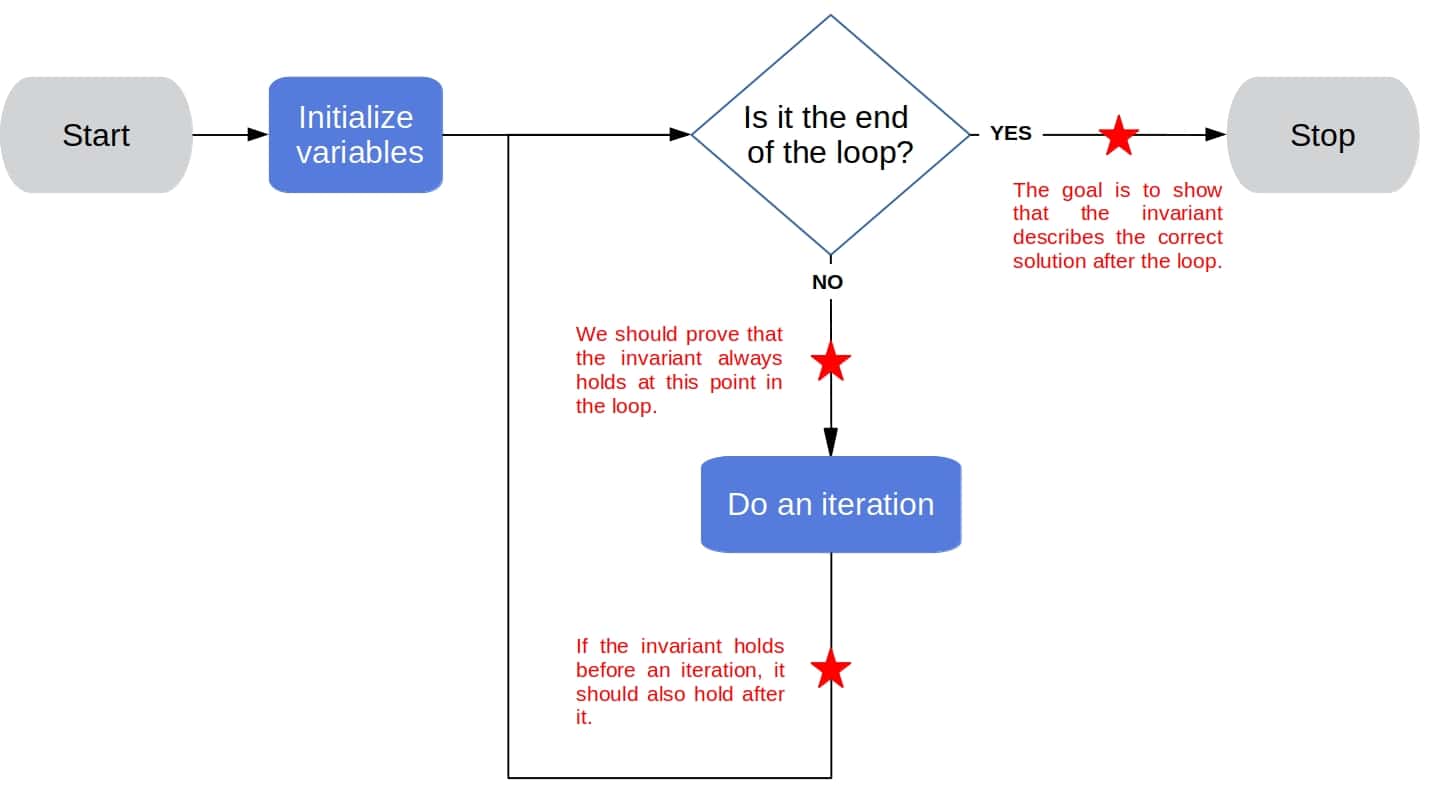
For Algorithm 1, we’d prove the invariant in two steps.
At the beginning of the loop,  and
and  . The sum
  is the sum of no numbers. We can use
  as its value, so we see that the invariant holds before the first iteration.
Let’s say that the invariant holds at the beginning of the -th iteration:
![\[s=\sum_{j=1}^{i-1}a_j\]](/wp-content/ql-cache/quicklatex.com-d6826fffe74ee23ceb523ebcc5232e07_l3.svg "Rendered by QuickLaTeX.com")
During the iteration, we add  to , so we get
![\[s=a_i+\sum_{j=1}^{i-1}a_j\right=\sum_{j=1}^{i}a_j\]](/wp-content/ql-cache/quicklatex.com-aec9889e43cac4f6acdcf9c5b0830164_l3.svg "Rendered by QuickLaTeX.com")
at the end of the iteration. The end of iteration  is the same as the beginning of iteration
  , so the second condition is also fulfilled.
As we’ve shown that
at the end of the loop, proving the invariant also verified that our algorithm was correct.
If the loop is a for–loop, the beginning of an iteration is the point after the loop counter is incremented, but before the loop termination test. That also applies to checking the invariant before the loop.
Let’s now work out two more examples.
Let’s say that we have two  -bit binary numbers:
  and
and  (
( for each ). The result of their addition is an
  -bit binary number
  . We can calculate each digit
  by adding
  and
and  together with the carryover from
  :
:
algorithm sumBinaryNumbers(x, y):
    // INPUT
    //     x, y = two n-bit binary numbers
    // OUTPUT
    //     z = the sum of x and y

    c <- 0
    z <- reserve n bits for the result
    for i <- 1 to n:
        z[i] <- (x[i] + y[i] + c) mod 2
        c <- (x[i] + y[i] + c) div 2
    z[n+1] <- c

return zTo verify its correctness, we’ll use a loop invariant which states that  is the correct result:
At the beginning of the -th iteration, the number  is the sum of
  and
and  .
.
Would proving this invariant make sure that the returned variable, , really is the correct solution? At the end of the loop, , so per the invariant, the number  would be the sum of
  and
and  . This means that we chose the right invariant for if we prove it, then we’ll also prove that our algorithm is correct.
Before the first iteration of the main loop,  and
and  . Since there is no digit
  , we take to be the solution and the only digit. Similarly, there are no digits
  and
and  in
in  and
and  so we practically have no numbers to add. We can treat the sum of no numbers as being equal to . So, the invariant is true before the first iteration.
If the invariant holds at the beginning of iteration , does it hold at the beginning of iteration  ? Let’s assume that
  is indeed the sum of
  and
and  . How do we compute digit ? We sum digits and together with the carryover term
  from the last iteration in which we computed . When we divide
  by
by  , the integer remainder is digit and the quotient is the carryover term for the next iteration, which proves that the invariant will be true at the beginning of the next iteration:
 |
|
|
|
 |
|---|---|---|---|---|
| 0 | 0 | 0 | 0 | 0 |
| 0 | 0 | 1 | 1 | 0 |
| 0 | 1 | 0 | 1 | 0 |
| 0 | 1 | 1 | 0 | 1 |
| 1 | 0 | 0 | 1 | 0 |
| 1 | 0 | 1 | 0 | 1 |
| 1 | 1 | 0 | 0 | 1 |
| 1 | 1 | 1 | 1 | 1 |
The Insertion Sort Algorithm is an  sorting algorithm:
algorithm insertionSort(a):
    // INPUT
    //     a = an array of n real numbers (1-based indexing)
    // OUTPUT
    //     The non-decreasingly ordered permutation of a

    for j <- 2 to n:
        x <- a[j]
        i <- j - 1
        while i > 0 and a[i] > x:
            a[i + 1] <- a[i]
            i <- i - 1
        a[i + 1] <- x
return aLet’s define the main loop’s invariant:
At the start of each iteration of the for–loop, the subarray ![\boldsymbol{a[1], a[2], \ldots, a[j-1]}](/wp-content/ql-cache/quicklatex.com-0305697c98557e343f813c596a1ba116_l3.svg "Rendered by QuickLaTeX.com") consists of the elements originally in on the positions
consists of the elements originally in on the positions  through
  , but in sorted order.
Is this a good invariant? At the end of the for–loop,  , so the invariant will state that the whole is sorted.
We see that  before the first iteration. So, the invariant claims that [
 ] is a sorted array. It (trivially) holds just as we assumed that zero can be taken as the sum of no numbers.
Let’s suppose that ![a[1] \leq a[2] \leq \ldots \leq a[j-1]](/wp-content/ql-cache/quicklatex.com-61d191b8a54c288b7f9e972260dcabaf_l3.svg "Rendered by QuickLaTeX.com") and that we set
and that we set  to
to ![a[j]](/wp-content/ql-cache/quicklatex.com-2afd9b90234378f963da9f507a4435cf_l3.svg "Rendered by QuickLaTeX.com") at the beginning of an iteration. We need to prove that after the inner while–loop, the elements
at the beginning of an iteration. We need to prove that after the inner while–loop, the elements ![a[i+1], a[i+2], \ldots, a[k-1]](/wp-content/ql-cache/quicklatex.com-11badd7415785efed4daad0613132e15_l3.svg "Rendered by QuickLaTeX.com") are greater than (the original ) and that
are greater than (the original ) and that ![a[1], a[2], \ldots, a[i]](/wp-content/ql-cache/quicklatex.com-678eebfbdc2f96cb841b34f335631309_l3.svg "Rendered by QuickLaTeX.com") are lower than or equal to .
are lower than or equal to .
We can formally prove that by proving the corresponding loop invariant for the while–loop. But, informally, we see that the while–loop moves the elements of one place to the right as long as they’re greater than . When the loop stops, that’s because it found the element (![a[i]](/wp-content/ql-cache/quicklatex.com-42e34b2b8788502423ed7c709a1494a6_l3.svg "Rendered by QuickLaTeX.com") ) which is lower than or equal to . Therefore, all the elements which were moved to the right, and those are
) which is lower than or equal to . Therefore, all the elements which were moved to the right, and those are ![a[i+1], a[i+2],\ldots,a[j-1]](/wp-content/ql-cache/quicklatex.com-926b33411bbe3d48a4a22f10ead7e9ad_l3.svg "Rendered by QuickLaTeX.com") , are greater than
, are greater than ![x=a[j]](/wp-content/ql-cache/quicklatex.com-22ff6bd584d0e44b0827e8bc12be4d11_l3.svg "Rendered by QuickLaTeX.com") . All those unaffected by the while–loop are lower than : . So, when we place at the -th position in , the whole subarray will be sorted.
. All those unaffected by the while–loop are lower than : . So, when we place at the -th position in , the whole subarray will be sorted.
In proving that an invariant holds before the first iteration, we usually rely on statements such as:
Those are the statements we can take to be true without proof. They’re called trivial and are widely used in proving base cases.
In this article, we explained what’s a loop invariant and showed how to prove it. We also worked out a couple of examples to illustrate how we can use a loop invariant to verify an algorithm’s correctness.