
Learn through the super-clean Baeldung Pro experience:
>> Membership and Baeldung Pro.
No ads, dark-mode and 6 months free of IntelliJ Idea Ultimate to start with.
Last updated: May 16, 2023

Learn through the super-clean Baeldung Pro experience:
>> Membership and Baeldung Pro.
No ads, dark-mode and 6 months free of IntelliJ Idea Ultimate to start with.
As a software testing professional, understanding the defect life cycle, also known as the bug life cycle, is crucial to ensure software quality.
In this tutorial, we’ll explore the stages of the defect life cycle and their importance in ensuring software quality.
We can define the defect/bug as the abnormal behavior of any software. The defect life cycle is a process that describes the stages of a defect from discovery to closure. By following the defect life cycle, we can ensure that defects are discovered, documented, and resolved in a structured and efficient manner.
We have seven steps in the defect life cycle. Let’s look at each one of them in the following subsections.
Everything starts by discovering that a defect exists.
We can discover defects during various stages of software development, such as design, coding, testing, or even after the software has been released. For example, during the testing phase, a tester may encounter a functionality issue or unexpected software behavior, which indicates a defect.
Once we discover the defect, we must log it into a defect tracking tool, such as JIRA, Bugzilla, or Trello. This process involves capturing as much information as possible about the defect, such as its severity, priority, and steps to reproduce it.
Let’s consider a software crashing example scenario. A tester may log this defect with the following information:
In this phase, the project manager reviews and assigns the defect’s severity and priority. The severity level indicates the impact of the defect on the system, while the priority level indicates the urgency to fix the defect.
For example, a critical defect with a high priority may need to be fixed immediately to avoid causing significant damage to the system or the end-user experience.
After triaging a defect, we should assign it to a developer who will work on resolving the defect. The developer receives all the necessary information about the defect, such as its reproduction steps and the expected behavior to resolve the issue.
The developer starts working on fixing the defect. Once the developer completes the fix, they mark the defect as “Fixed” in the defect tracking tool.
For example, a developer may fix the above-mentioned defect by identifying the code responsible for the crash and correcting it. After the fix is complete, the developer marks the defect as “Fixed”.
After fixing the defect, we need to verify the fix. The tester verifies this by executing the test cases related to the defect. If the tester finds the fix does not solve the defect, it is reassigned/reopened.
For example, a tester may verify the fix for the above-mentioned defect by repeating the steps to reproduce the issue and checking that the software no longer crashes when clicking the “Save” button.
Once the defect has been verified, it is marked as “Closed” in the defect tracking tool. The defect is considered closed when it meets the criteria for closure, such as passing all the related test cases and receiving approval from the project manager.
Let’s look into the visual representation of the various stages that a software defect goes through, from its discovery to closure:
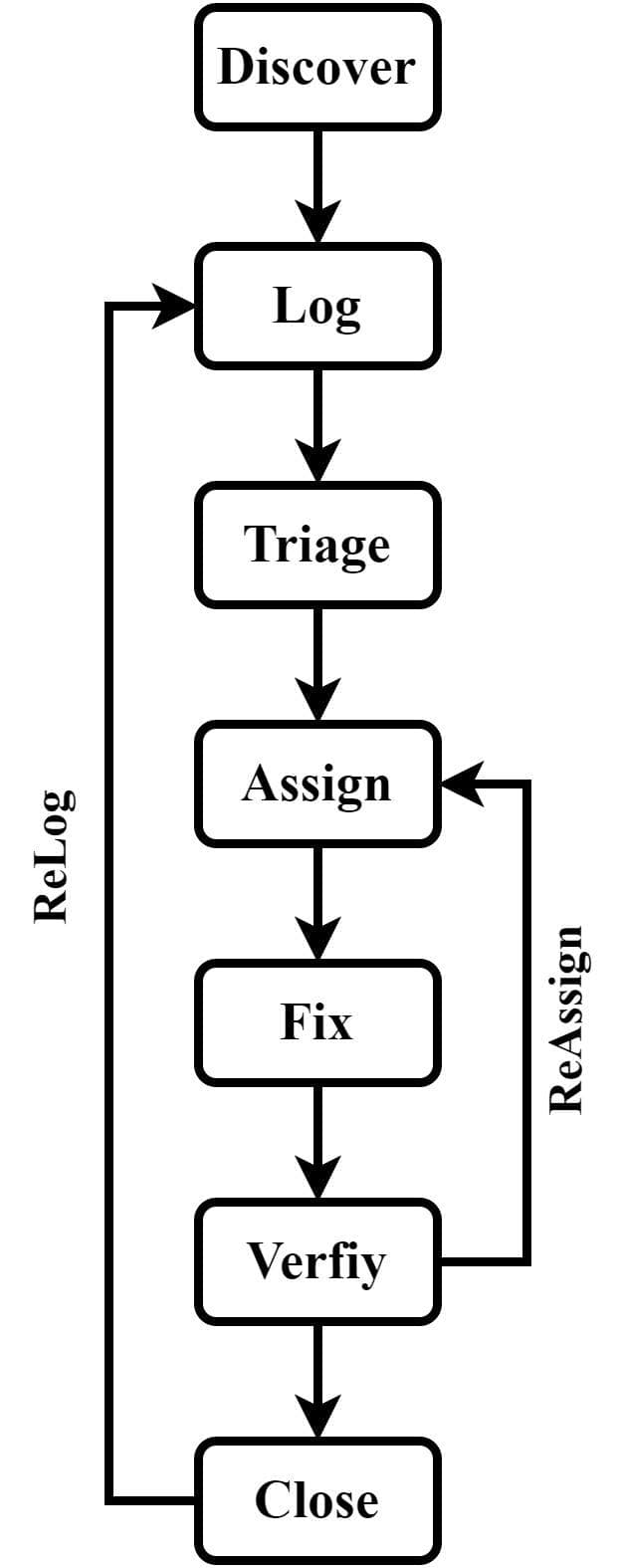
As we can see, the defect life cycle involves multiple stages, from triaging and assigning defects to developers for fixing to verifying the fix. If a previously closed defect is found to have a similar issue, it may be reopened and assigned for fixing again.
Sometimes, after a bug has been reported and worked on, it goes through a few different states before it is resolved. Here are some examples of those states:
The defect life cycle in Agile Environment differs from traditional software development because it is iterative and incremental.
Agile methodologies, such as Scrum and XP, involve continuous testing and integration, which allows defects to be discovered and addressed early in development.
The stages in the defect life cycle in the agile environment include discovery, logging, triage, assignment, fixing, testing, and closure. But, unlike traditional software development, these stages are not always linear and may overlap or simultaneously happen.
For example, defects may be discovered during testing and immediately fixed by the developer without going through the triage and assignment stages.
In this tutorial, we’ve looked into various stages of the defect life cycle. The defect life cycle is a crucial aspect of software testing and development, ensuring defects are identified, tracked, and resolved systematically.
The defect life cycle is essential for ensuring software quality and reducing the risk of defects. It provides a standardized approach to defect management, allowing teams to identify and address defects promptly and efficiently.